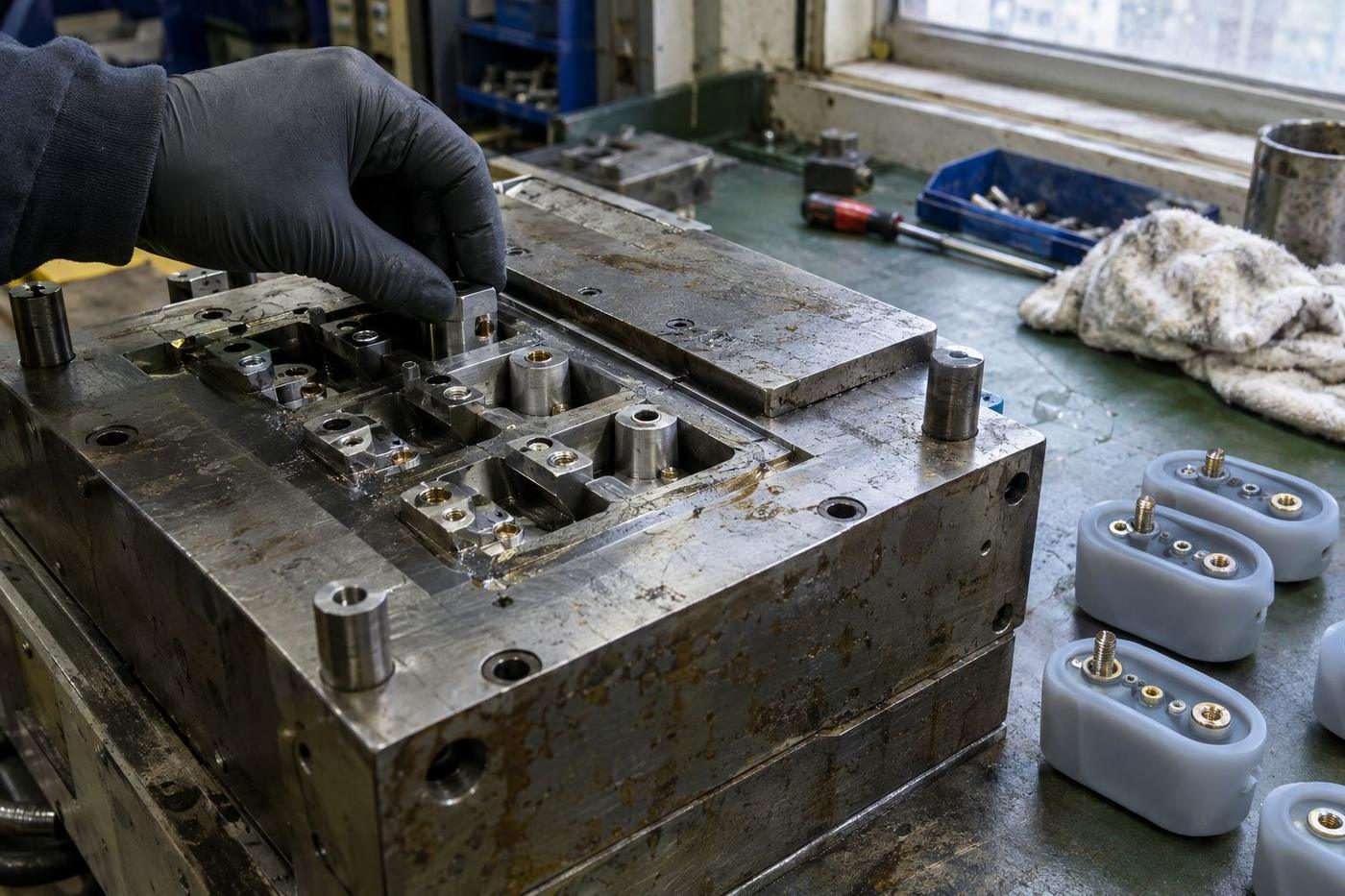
Metal insert moulding
Anti-vibration mounts, bonded seals, grommets with metal sleeves. Metal insert moulding creates a permanent bond between rubber and metal…
Open this variantCombined route · insert loaded, silicone moulded around
A pre-made insert — a threaded stud, a metal contact, a printed circuit, a stiffening plate — placed into the tool cavity, then silicone or rubber moulded around it. The insert becomes structurally part of the moulded part.
Why insert-mould
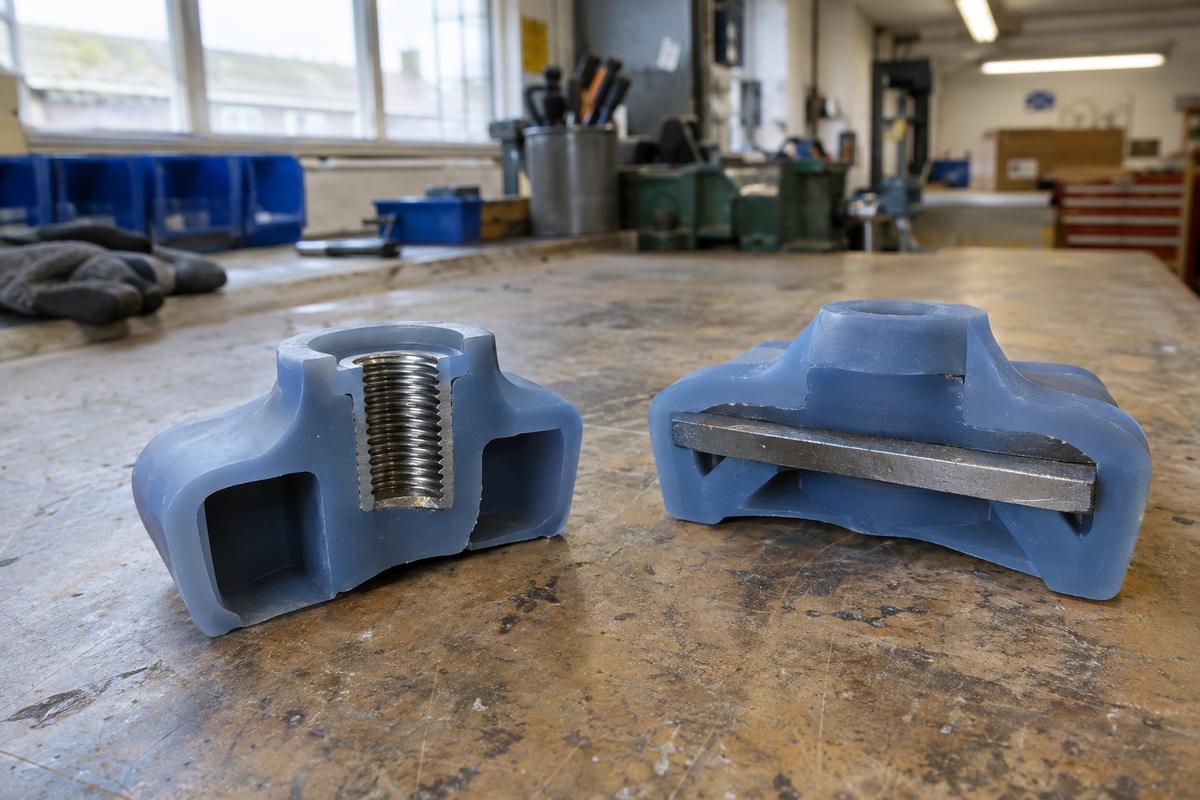
A threaded metal insert moulded into silicone is captured. Nothing you assemble to it can pull it out. The alternative — moulding the part, drilling it, pressing an insert in — always risks the insert coming loose under load, temperature cycling, or vibration.
The same principle applies to any component you want permanently located inside the moulded part: a metal contact for an electrical connection, a stiffening plate that stops the silicone from stretching in a specific direction, a printed circuit that needs to sit in a defined position, a threaded stud for later assembly.
The insert arrives at the tool, is located in the cavity (by hand or by a pick-and-place robot), and the tool closes around it. Silicone or rubber flows in and cures. The finished part comes off the press with the insert permanently in place.
It's not exotic — most of what we mould at volume for OEMs has some form of insert in it. What matters is designing the insert-location features into the tool so the operator can't put the insert in wrong.
Drill down
Each variant has its own page with the specifics: where it fits, how we run it and what to send us.
Anti-vibration mounts, bonded seals, grommets with metal sleeves. Metal insert moulding creates a permanent bond between rubber and metal…
Open this variantA rubber foot with a stud, a bumper with a threaded boss, a mount you can bolt through. Moulding the fixing into the part removes an…
Open this variantWhere inserts help
Studs, brass inserts, threaded bushes. Moulded in, they're captured for the life of the part. Assembly torques them without worrying about pull-out.
Metal contacts moulded into a silicone housing; a small PCB moulded into a wearable's silicone shell. Silicone becomes the case, the insert stays put.
A metal or plastic plate embedded in silicone to control how the part deforms under load. Useful on flexible parts that need to resist stretching in one direction.
How it runs
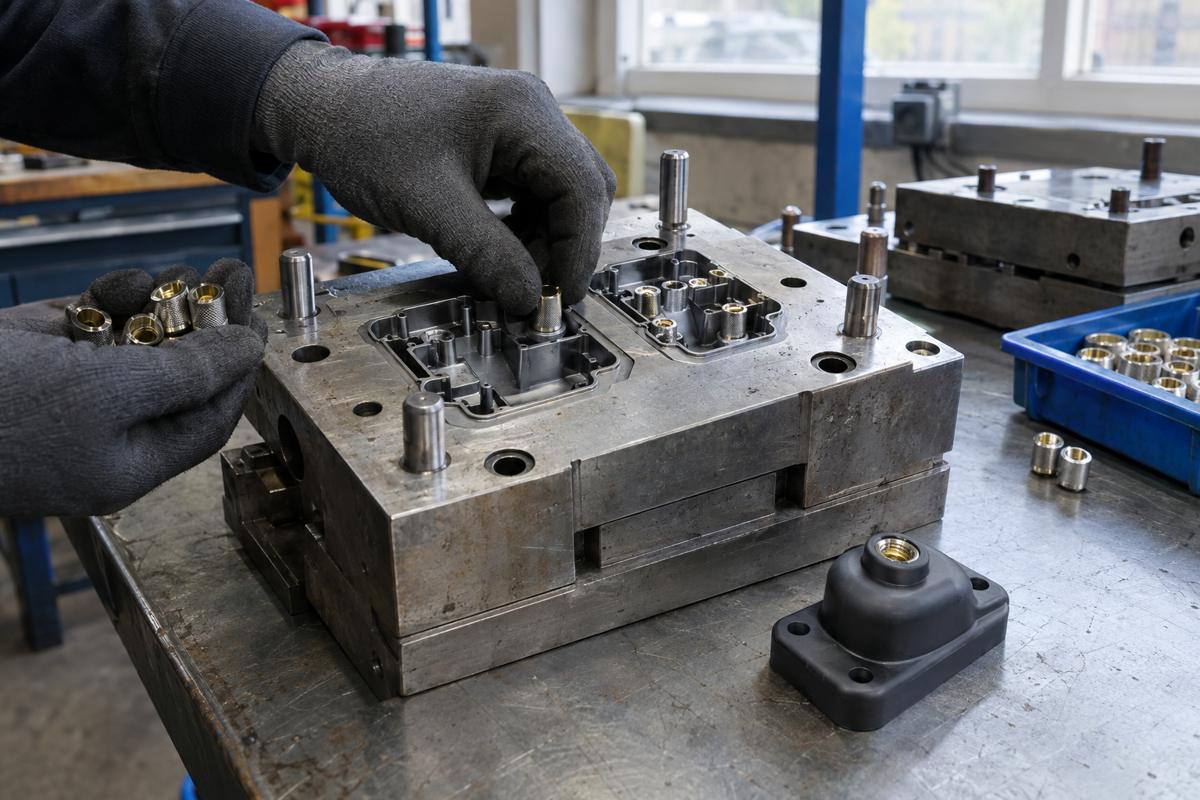
The mould cycle is standard. The extra work is on the loading — the tool has to hold the insert accurately, and the operator or robot has to place it right every time.
Inserts arrive from you or from a nominated supplier. They're cleaned if needed, checked to spec, and — if the bond is chemical — primed.
The operator places the insert onto locating pins or magnets in the tool. On higher-volume cells, a pick-and-place robot loads them and a vision system verifies orientation.
The tool closes around the insert and the silicone flows in. Correct tool design keeps the insert in position through the fill; a badly designed cavity can shift the insert mid-cycle.
Cure completes. The part is ejected with the insert now bonded or mechanically captured inside the moulded body.
First-off parts are checked for insert position and bond. On a defined interval, we pull-test to confirm the insert is fully captured.
To quote it
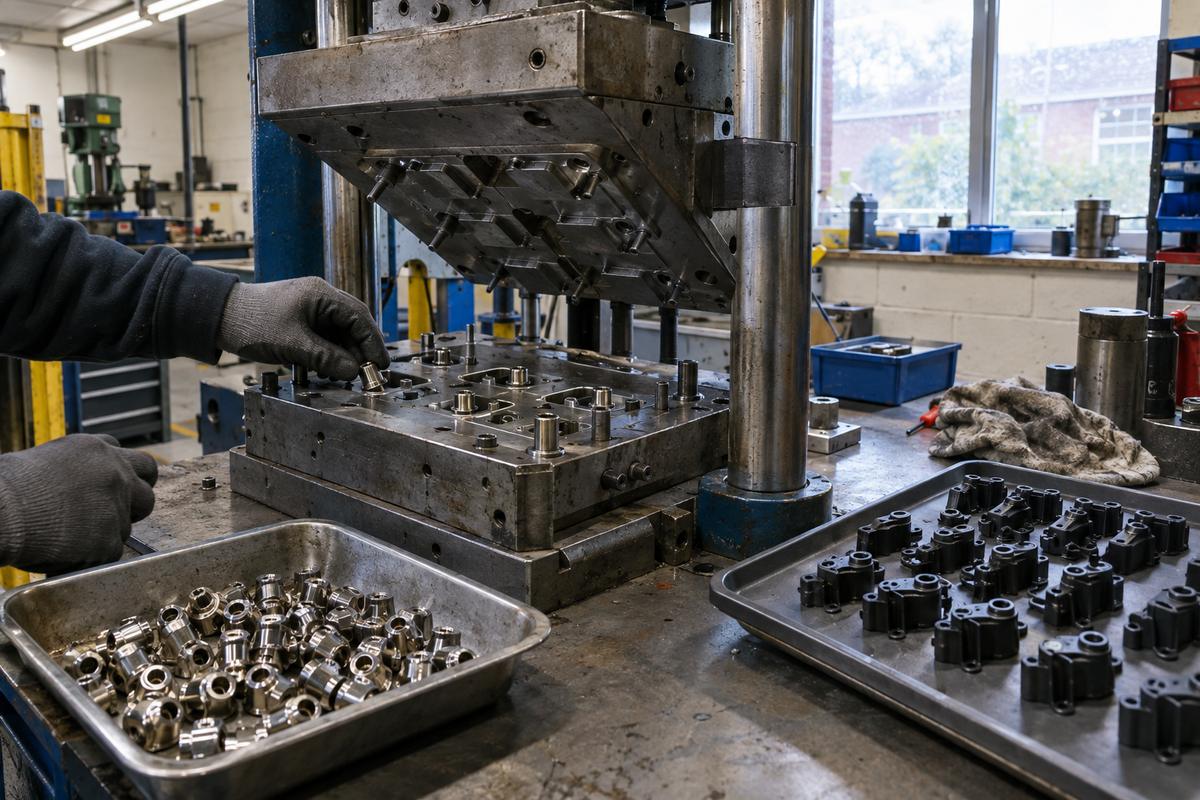
What it looks like, what it's made of, what its position tolerance is, and whether you supply it or want us to source it.
Chemical primer on the insert, mechanical interlock designed into it, or both. Each has different cost and different reliability.
Manual loading is fine for a few thousand a year. Above that, robotic loading pays for itself in labour and consistency.
For medical or electronics work, insert batches travel with the shipment alongside the silicone batch. That's built into the run record.
Related routes
Silicone or rubber moulded directly onto a pre-made substrate — a plastic housing, a metal insert, a printed circuit assembly — so the finished part…
Read moreTwo materials moulded in a single cycle on a press configured for both — usually a rigid plastic first, then silicone bonded onto it, without ever…
Read moreSilicone moulding for electronics OEMs — insulating gaskets, sealing membranes, keypad mats, connector boots, enclosure seals. Electronics-grade…
Read moreAt a glance
How overmoulding works
Swipe to see the whole diagram
From drawing to delivered parts
Swipe to see the whole diagram
Get in touch
Rough annual volume, target unit price, and any deadlines. That's enough to work out whether compression, LSR injection or something else is the right tool.
Real people, a real workshop
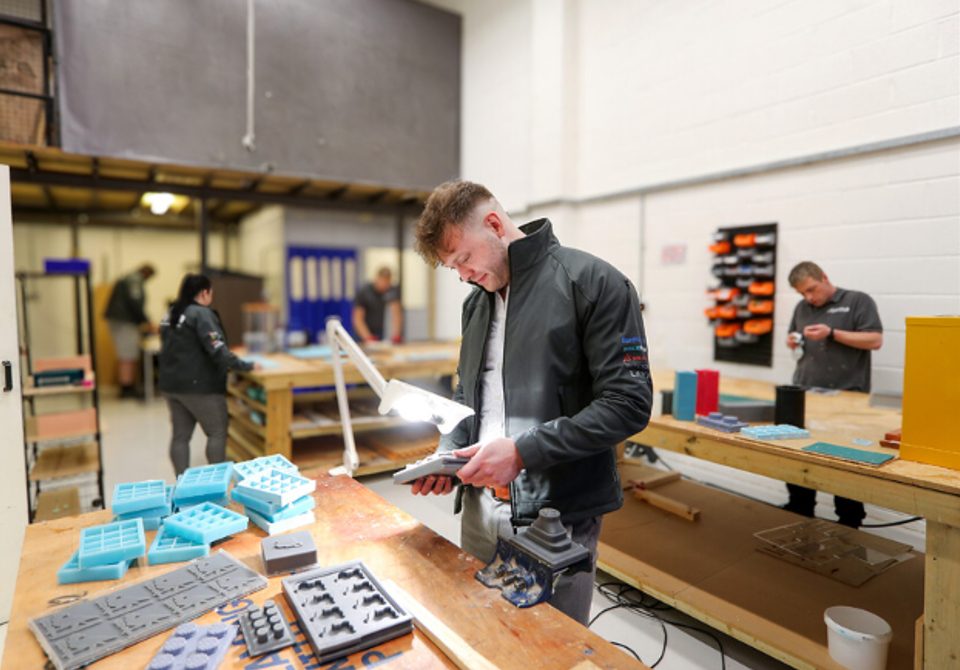
No call centre and no middlemen. When you contact TCI Products, you speak to the team who design, build and check your mould.


 Thomas LaneManaging Director
 George PrestonDesign & Project Manager
 Kelly BallingerHead of Partnerships
 Jim AndertonProduction Manager
 TheodoreEmployee Welfare