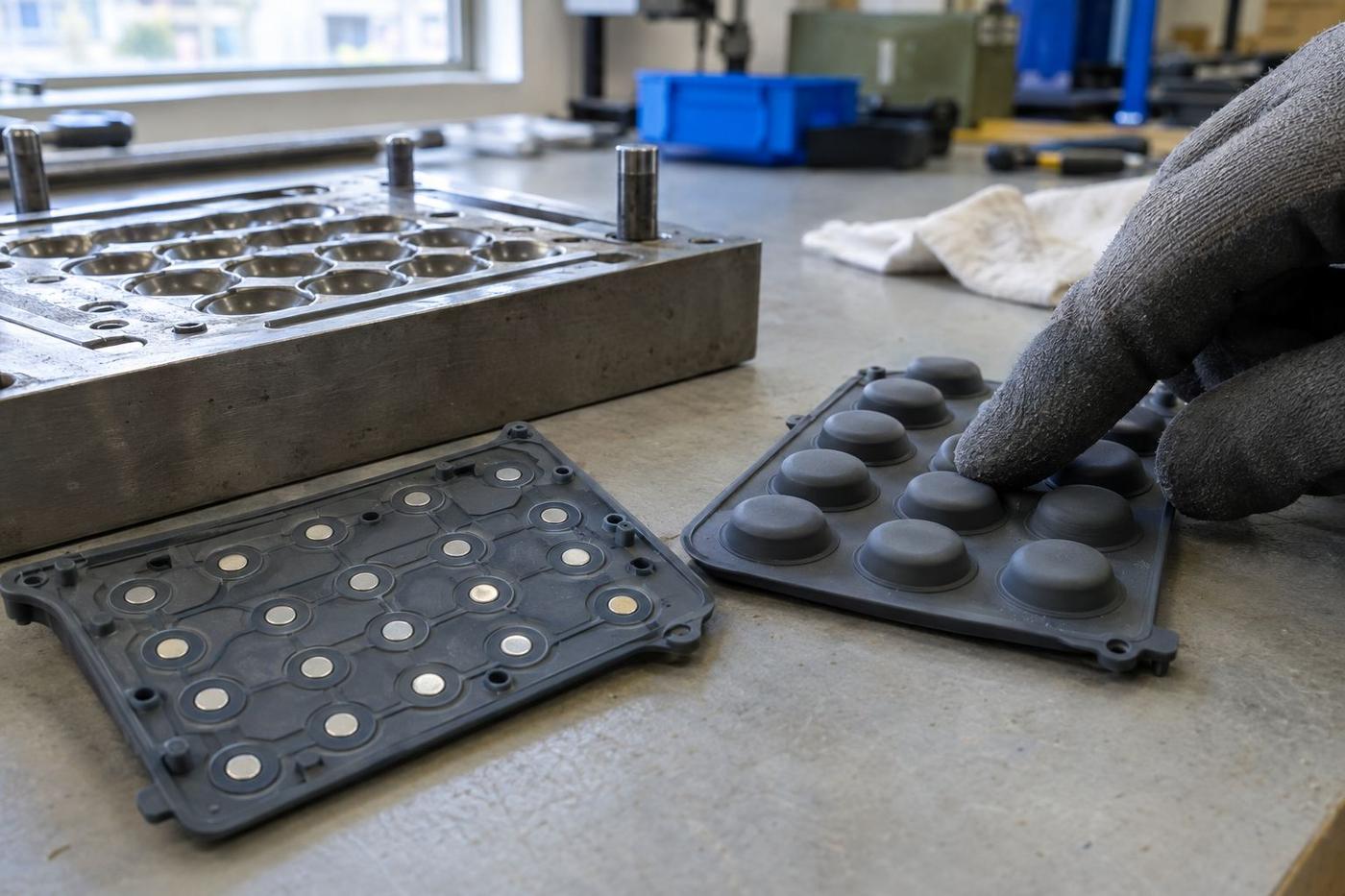
Silicone keypads
A keypad is what people touch every time they use your product. The feel of every key, the legibility of every legend and the seal around…
Open this variantOEM route · tactile input components
Silicone keypad mats and moulded buttons with a defined tactile feel, integrated conductive contacts, and graphics either printed on top or moulded into the surface. The full assembly, out of one tool, into your device.
What a keypad has to feel like
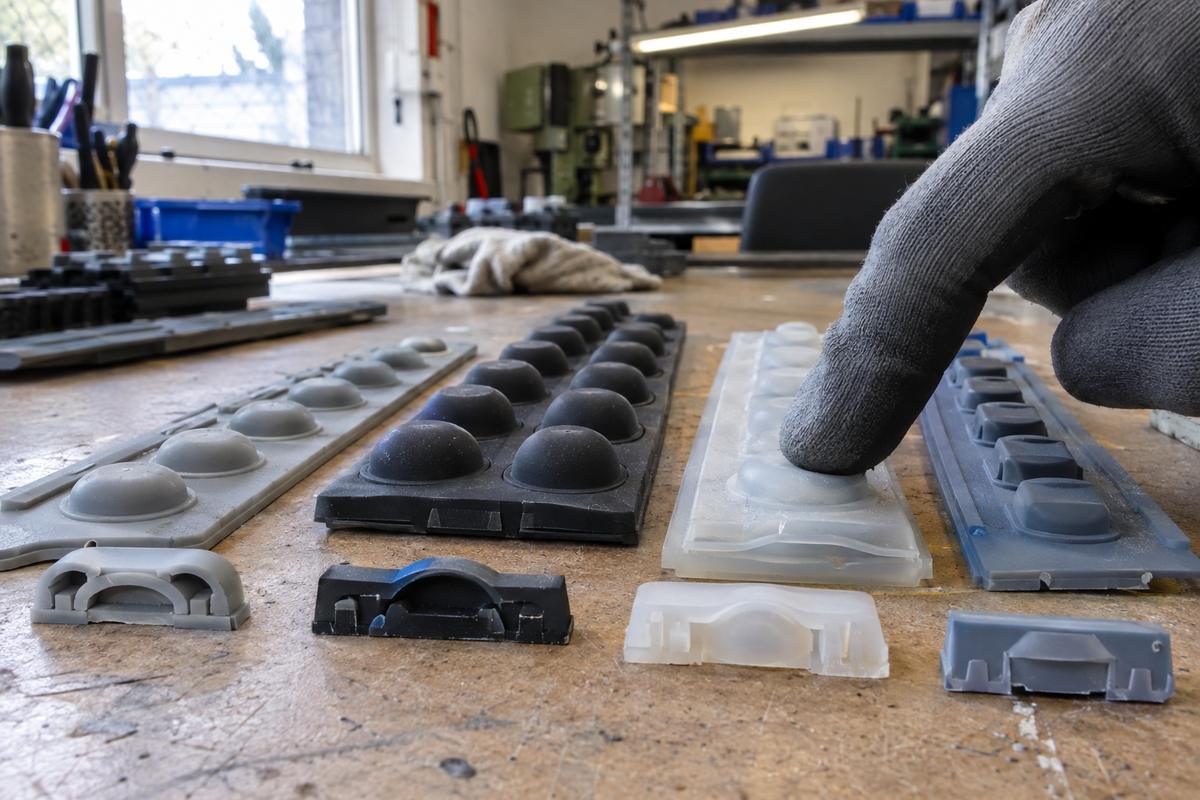
A silicone keypad works because of three geometric features: the dome (which gives the click), the actuator (which travels down to touch the switch), and the web (which holds the buttons in the mat). Get those three right and the keypad feels considered. Get any of them wrong and it feels cheap.
The dome geometry drives the actuation force and the click sensation. Steep-walled domes give a sharp click at higher force; shallow domes give a softer, longer-travel feel. We'll press samples in a few dome variants and let your product manager choose by feel, not by force spec.
Conductive pill contacts — small carbon or gold-plated pucks moulded into the underside of the button — close a circuit on your PCB when the button is pressed. They can be moulded into the silicone in one shot or added as an insert in a second operation.
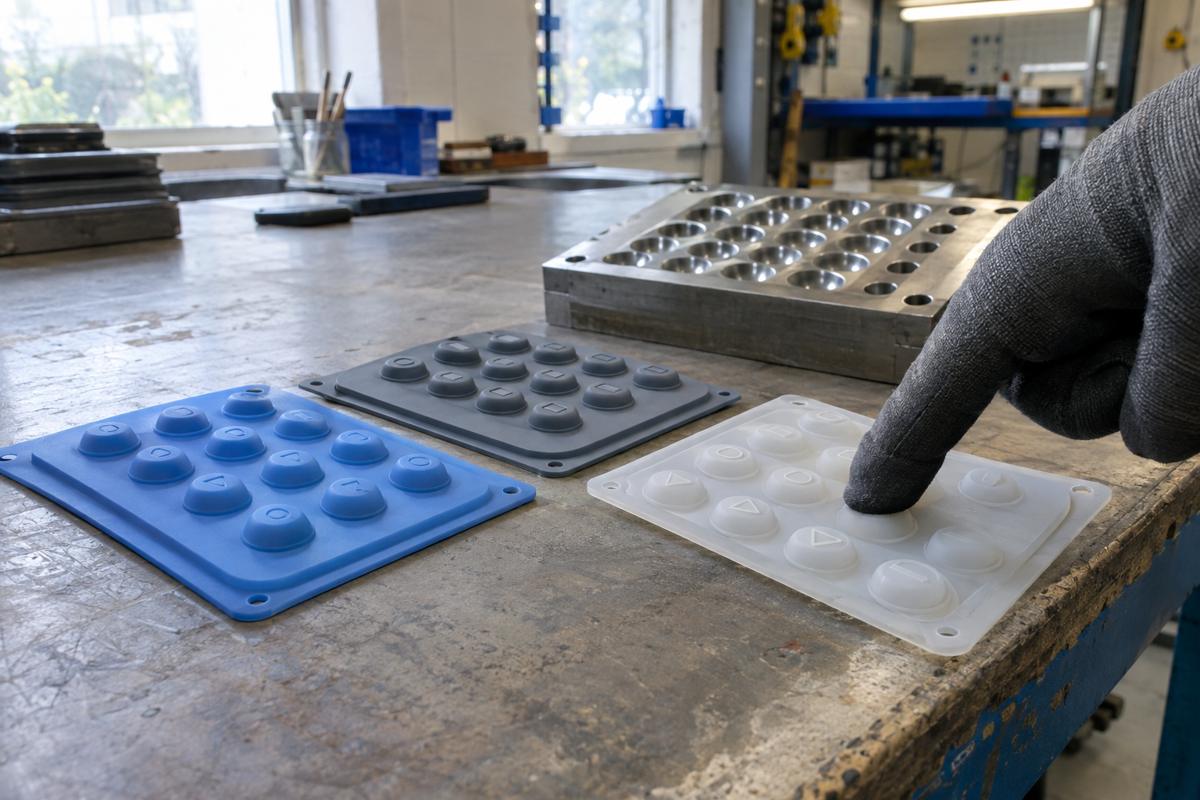
Graphics on the button top can be printed after moulding (silicone-compatible pad-print inks) or moulded in through a laser-etched cavity that leaves raised or recessed text. Which route depends on how permanent the graphic needs to be.
Drill down
Each variant has its own page with the specifics: where it fits, how we run it and what to send us.
A keypad is what people touch every time they use your product. The feel of every key, the legibility of every legend and the seal around…
Open this variantA backlit key needs light to pass through the legend and nowhere else. That takes translucent silicone, opaque coatings and careful control…
Open this variantSome products have one button. It might be the only part of the product people deliberately touch. It has to feel exactly right.
Open this variantHow the keypad comes together
The silicone mat is moulded, then graphics are pad-printed on the button tops. Standard route for most consumer keypads.
The tool cavity has the graphic laser-etched into it, so the graphic is part of the moulded silicone. Permanent and can't wear off, but changes to the graphic mean a new tool feature.
Conductive contacts are moulded in during the run — carbon pucks or gold-plated pills placed by robot before the tool closes.
How a keypad run works
The dome and the actuator get set in the tool. Everything else is a decision about what happens on top of the base moulding.
We press sample mats in three durometers with the proposed dome geometry. You wear-test them; we adjust the design based on what actually feels right, not on the spec sheet.
The tool is cut. If graphics are moulded rather than printed, the graphic cavity is laser-etched before final polish.
Contacts placed by hand or by robot depending on volume. First-off mats are electrically tested to confirm the contacts close the circuit at the specified force.
Graphics pad-printed with silicone-compatible ink; UV coated for wear resistance if the device is going to see heavy use.
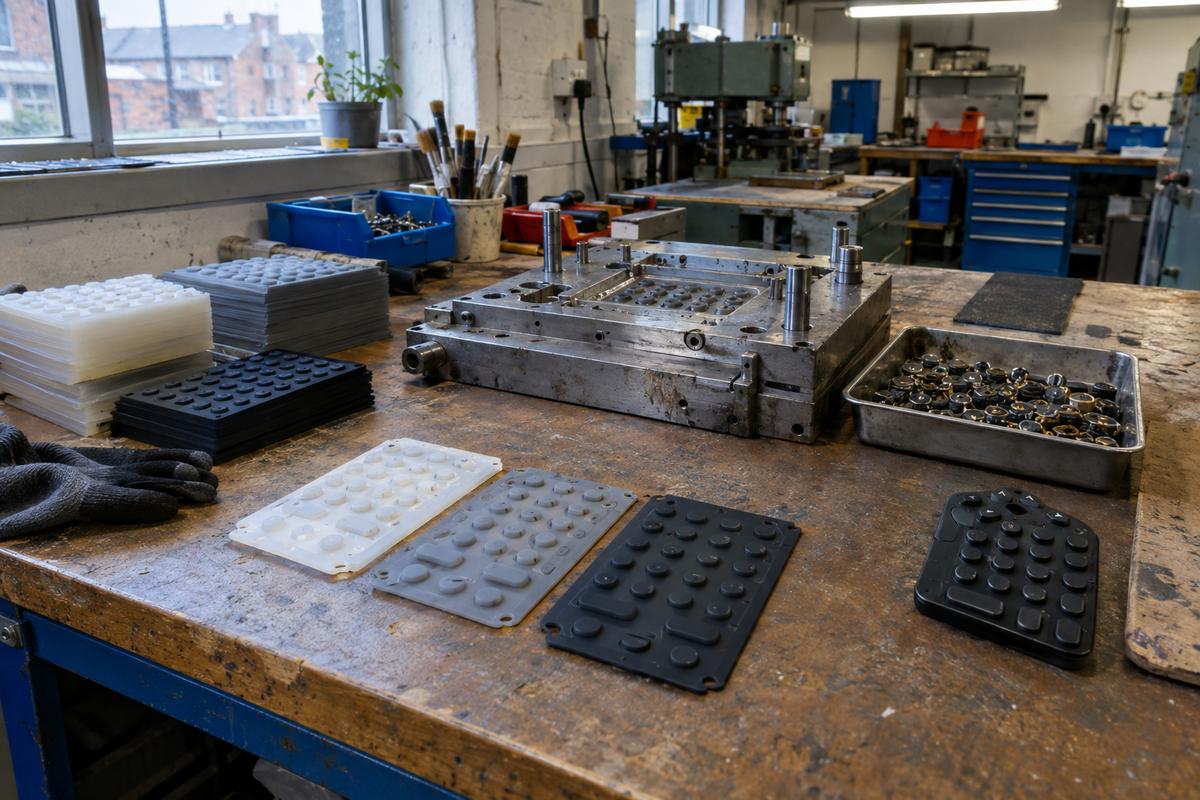
Mats packed in trays, oriented for your pick-and-place. Batch record travels with the shipment.
To quote it
Button positions, sizes, and any keep-out zones. If you have a target actuation force in mind, tell us — we'll aim for it in dome design.
Printed, moulded, or coated. Whether you need graphics to survive an alcohol wipe test, or just look right in a domestic setting.
Do you need conductive pills, or is your device using a separate switch layer? That changes tool cost and cycle time significantly.
Keypad tools are usually multi-cavity; if you have several button variants, we can run them off shared tool bases with variable inserts.
Related routes
Solid silicone or rubber pre-formed, loaded into a heated steel tool, and pressed under cure. Sensible tooling cost, thousands of parts per tool, and…
Read moreA pre-made insert — a threaded stud, a metal contact, a printed circuit, a stiffening plate — placed into the tool cavity, then silicone or rubber…
Read moreSilicone moulding for electronics OEMs — insulating gaskets, sealing membranes, keypad mats, connector boots, enclosure seals. Electronics-grade…
Read moreGet in touch
Rough annual volume, target unit price, and any deadlines. That's enough to work out whether compression, LSR injection or something else is the right tool.
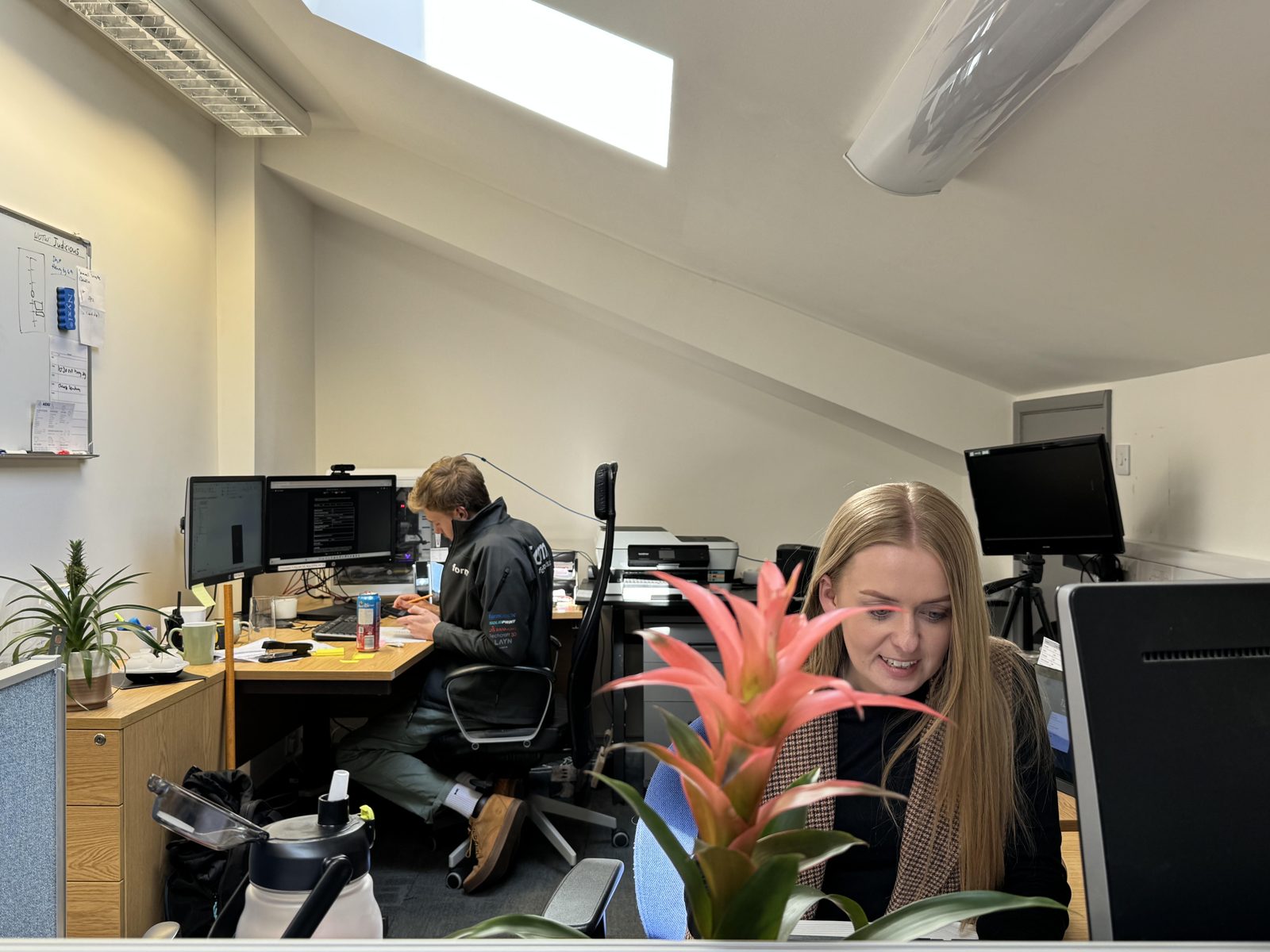
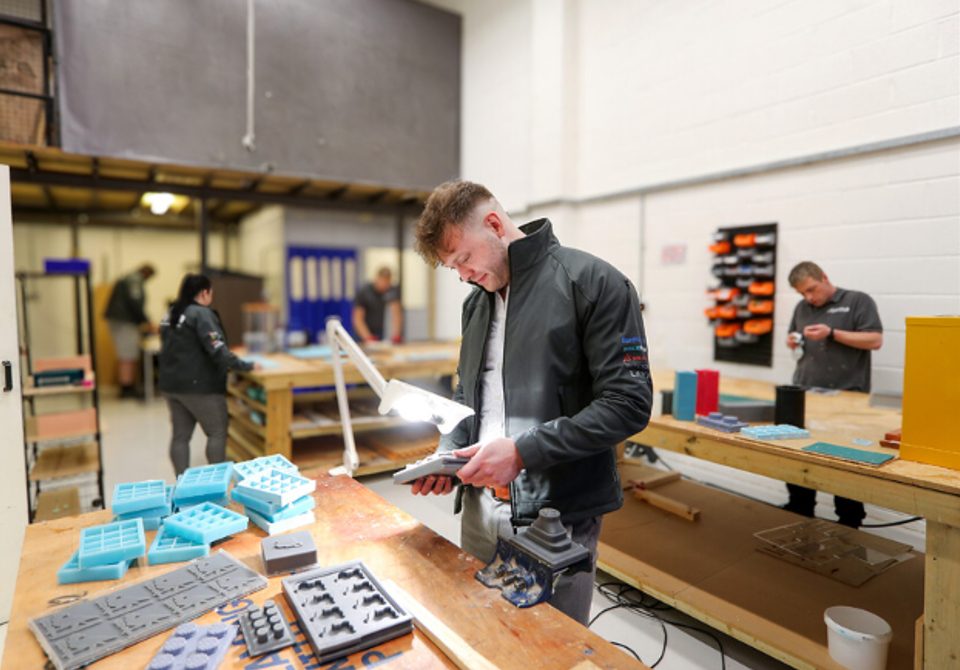
Real people, a real workshop
No call centre and no middlemen. When you contact TCI Products, you speak to the team who design, build and check your mould.
 Thomas LaneManaging Director
 George PrestonDesign & Project Manager
 Kelly BallingerHead of Partnerships
 Jim AndertonProduction Manager
 TheodoreEmployee Welfare